


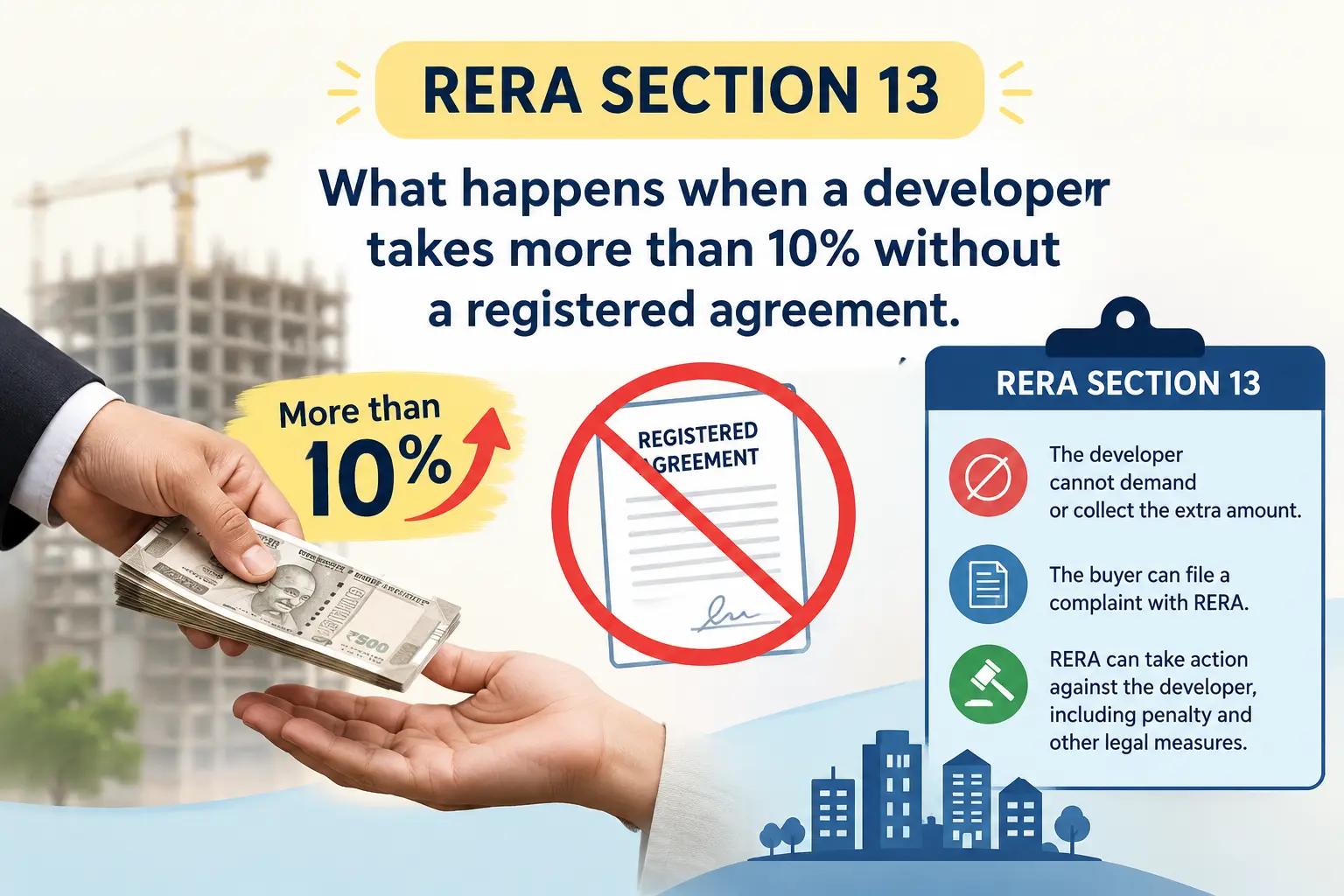
Section 13 (1) rule is a hard ceiling, not a guideline. A promoter cannot take more than 10% of the cost of the unit as advance or application fee until a written agreement for sale is signed and registered. This is the answer in short! This section covers two duties that a promoter is bound to follow- first sign an agreement and second register it.
Importantly, the 10% is of cost of the apartment, building or plot, not anything else. Promoter or the sale team might advertise pre-launch labels with expressions like token, application fee, booking fee, or soft booking that does not take it outside section 13. A violation of section 13 puts the promoter in grave danger than the buyer. An unregistered agreement, makes the deal enforceable against you and hard to enforce for you. Buyers keep their rights, but Promoters don’t.
The Standard Agreement for Sale
Clause 2 of section 13, controls what the agreement must contain. It is a comprehensive document that codifies the entire real estate transactions. Each State under its rules prescribes a modal form of agreement, a Promoter may add terms, but not in violation of the modal agreement. In general, it requires the agreement to specify the particulars of development, the dates for possession, and the payment schedule with the interest payable on default by either side. The instalment structure has to be tied to that agreement, which is another reason the agreement cannot be pushed to the end of the sale process.
Consequences of violating the 10% rule
While a builder disregards the provisions of section 13 and collects the arbitrary amounts without a registered agreement, it violates the primary direction of RERA. Buyers have strong remedies against this.
- A Rera complaint, a direction to stop collecting.
The Authority might issue a restraint order at first, and direct to execute the agreement for sale and may restrain further demands until this is done. This puts the developer in bad state, because a stop on demands stops the collection line for the whole tower, not just the complainant's unit.
- The Forfeiture clause cannot be executed.
The builder is stopped from forfeiting the earnest money if the agreement was not registered. Theirs no proof/document to point to when justifying a forfeiture. A unregistered agreement holds no value for a Promoter.
- Penalty under section 61.
Penalties under this section attracts 5% of the estimated cost of real estate project estimated by the authority. The Promoter pays a hefty amount is any direction is passed under this section.
Let’s look at the decisions already taken by Authorities and Tribunals
- In December 2025 order of MahaRERA in Vaibhav Singh v/s Accord builders in CC006000000490389, order dated 18.12.2025.
The Complainant booked a flat in M/s Omkar Meridia Project of Accord builders at Kurla West, Mumbai in December 2012. A total of ₹52.45 lakh was paid, of which ₹42.45 lakh went by cheque towards the flat consideration and ₹10 lakh in cash towards parking. That came to roughly 20% of the price. The builder gave allotment letter and choose to not sign, execute the agreement for sale.
In 2020, the builder terminated the allotment over non-payment and forfeited the amount paid till date. The buyer went before MahaRERA and argued that without a registered agreement the forfeiture was illegal, that the money was part consideration and not earnest money, and that the builder had suffered no loss because the flat was resold.
The Authority described RERA as social welfare legislation and held that a builder cannot forfeit the hard-earned money of the buyer without handing over the possession, especially when third party rights were already been created. It declared the forfeiture illegal and directed to refund 42.45 lakhs within 30 days, a failure would lead to simple interest at 2% above the State Bank of India’s highest marginal cost of lending rate until realization. The complaint was allowed to the extent of refund, with no order as to costs.
- Rajasthan RERA gave a similar decision in 2020, in Vinod Kumar Agarwal v. Jaipur Development Authority, Complaint No. RAJ-RERA-C-2020-3622, decided on 22-09-2020. The buyer approached the authority as the Promoter asked for 35% amount without registering the agreement for sale, it was in contradiction of section 13(1) of the Act. The authority directed to register the agreement first and not demand any amount until the registration is completed.
- Uttar Pradesh RERA in Rajendra Singh Rawat Vs. Sridhara Pvt. Ltd., Complaint No. NCR144/10/83508/2021 decided on 16.06.2022. The builder had forfeited more 10% on the consideration amount. The Authority directed the Promoter to only forfeit 10% of the amount and refund the remaining amount to the buyer despite, the withdrawal being initiated by buyers.
All the above judgment shows the clear picture and the consequences to be faced by builder/promoter for failing in any compliance or regulation.
The Courts above tested the RERA early, in Neelkamal Realtors Suburban Pvt. Ltd. and anr. v. Union of India and ors., Writ Petition No. 2737 of 2017
The case was filed challenging several provisions of RERA. This judgment specially gave a clarity to the pre-existing projects and their regulations under RERA. It drew a line between retrospective law, which reopens and nullifies past transactions, and retroactive law, which accepts a past transaction but regulates its future effects. It held that the provisions are not retroactive but to some extents are retroactive or quasi-retroactive.
This judgment is relevant for Section 13 because the Projects which were ongoing after Rera enforcement i.e. on or after 2016/2017 are under the ambit of Rera. The Promoter holding a letter of allotment and demanding monies from the buyer shall face a legal battle. It made signing and registration of agreement for sale, a compulsion for those projects as well.
THE FINAL TAKEWAY
To conclude, registration of AFS is not a paperwork lapse that gets fixed with a fine. It takes away the contractual defense of the Promoter while keeping the buyers right intact. The Cost shows up as refund with long-term interest, forfeitures that do not hold, accounts frozen. The Section 61 penalty of up to 5% of project cost is the headline, but it is usually the smallest line in the total.
The fix is unglamorous. Register early, use the model form, put a hard block in the receipting system at the 10% line, and sweep the legacy book before someone else does it for you.